Consent and notice · DP009
How to write a privacy notice customers can actually use
Write a usable DPDP notice by naming the information, explaining specific purposes and connecting customers to withdrawal, rights and grievance routes.
Research cutoff: . This dated explainer is general information; check the linked instruments and your circumstances before acting.

A useful privacy notice answers the question a customer has at the point of collection: why do you need this information, and what can I do about its use? A long document can fail that test. So can a short sentence that says only “we respect your privacy”.
The final framework’s notice requirements are in section 5 of the Act and rule 3. As of 22 October 2026, these provisions are scheduled for the May 2027 phase under the commencement notification. Businesses can prepare and test their notices now without presenting the requirement as already fully commenced.
Write from the actual form
Place the collection form beside a blank page. List each personal-data item it asks for and the purpose that justifies it. If the form collects a delivery address, phone number, birth date and job title, do not hide those differences behind “information necessary to serve you”.
Ask the form owner to explain what would fail if each item were removed. A courier might need an address and a contact number. A birthday field may support optional offers rather than delivery. This exercise can reveal that the form itself needs changing before the notice is drafted.
Rule 3 calls for an itemised data description, specified purposes and a specific description of the goods, services or uses enabled. Use the customer’s vocabulary while preserving the distinction between purposes. “Arrange delivery and send delivery updates” is more informative than “enhance the customer experience”.
Make the notice stand on its own
The rule requires the notice to be understandable independently of other information. A customer should not need to combine a sales contract, an FAQ and an inaccessible policy attachment to discover the essential explanation.
A layered design can help if the essential material remains clear and available. For example, a form can show a concise purpose explanation and a clearly labelled route to fuller detail. The legal requirement concerns usable information; it does not prescribe a universal screen size or a single layout for every business.
Do not use a link labelled “terms” when it leads to several unrelated documents. Labels should tell the reader what they will find. Test links from the same mobile device and browser a customer is likely to use.
A hypothetical notice rewrite
Consider an appliance installer whose form says: “Submit your details to receive our services and relevant communications.” The phrase does not explain whether communications mean appointment updates, future advertisements or messages from partners.
A better working draft separates the purposes. It names the contact and installation details used to schedule and complete the visit. It describes any optional marketing use separately. It then points to the actual route for withdrawing consent and raising privacy questions. This is an example of a drafting approach, not a complete notice that every installer can copy unchanged.
Before adopting it, the installer must confirm the fields, recipients, operating practices and applicable legal grounds. A notice that accurately describes an imagined process still misleads if the real business behaves differently.
Give the customer an action they can complete
Rule 3 requires particular communication links and other available means for withdrawal, exercising rights and making a Board complaint. These should connect to real workflows. An email address nobody monitors is a poor operational implementation even when it appears in the document.
Explain the internal grievance route clearly. Section 13 requires individuals to exhaust that opportunity before approaching the Board. Because the rights and main enforcement provisions are in the later phase, avoid claiming that every statutory Board complaint service is currently available without verification.
Sections 5(3) and 6(3) provide the option to access the notice or consent request in English or an Eighth Schedule language. Treat translation as part of the customer journey: the customer must be able to understand the notice and use the linked routes, not merely see a translated heading above English instructions.
Review it with a real task
Ask a colleague unfamiliar with the draft to find three things: what data is collected, which use is optional, and how to change their choice. Do not explain the notice while testing it. Their hesitation identifies places where the wording or interface needs improvement.
Keep the approved version, effective date, owner and the screens where it appears. When the form or purpose changes, review the notice at the same time. A version number is useful evidence only if the business can connect it to what the customer actually saw.
The finished notice should be specific enough to guide a decision and simple enough to use during a transaction. Its quality depends on the accuracy of the underlying workflow as much as the skill of the writer.
Build a notice from the collection journey
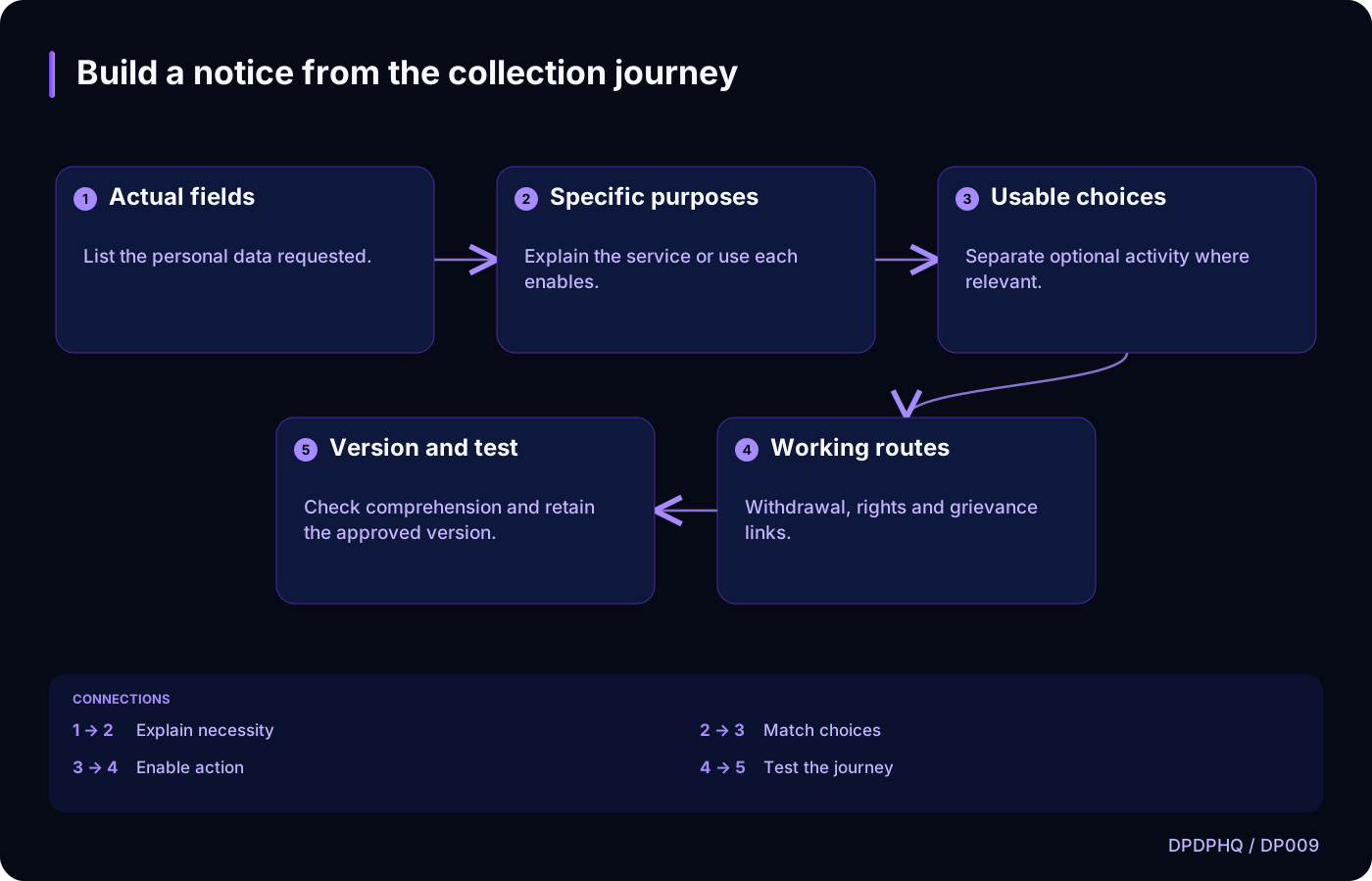
Text version of the diagram
- Actual fields: List the personal data requested.
- Specific purposes: Explain the service or use each enables.
- Usable choices: Separate optional activity where relevant.
- Working routes: Withdrawal, rights and grievance links.
- Version and test: Check comprehension and retain the approved version.
- Actual fields → Specific purposes: Explain necessity
- Specific purposes → Usable choices: Match choices
- Usable choices → Working routes: Enable action
- Working routes → Version and test: Test the journey
Sources and reading context
These references support the original 22 October 2026 research. Source links and the date above make the scope of this article explicit.
- Digital Personal Data Protection Act, 2023 · Sections 5, 6(3) and 13
Notice, language and grievance route
- Digital Personal Data Protection Rules, 2025 · Rule 3
Final notice content
- Commencement notification for provisions of the DPDP Act · Paragraph (c)
Prospective commencement