Consent and notice · DP011
How to separate order updates from promotional messages
Separate essential order communications from optional promotions, map the purpose of each message and keep campaign permissions out of delivery decisions.
Research cutoff: . This dated explainer is general information; check the linked instruments and your circumstances before acting.

A customer gives a phone number so a parcel can arrive. A month later, the same number receives a festival promotion. The business may see one contact record; the customer sees two different uses. A useful consent design starts by recognising that difference.
Under the notified DPDP framework, processing needs consent or a relevant certain legitimate use for a lawful purpose. Section 7(a) addresses voluntary provision for a specified purpose where refusal has not been indicated. As of 22 October 2026, these substantive provisions are scheduled for May 2027. See the Act’s processing grounds and commencement notification.
Classify the message by purpose
An order confirmation, delivery rescheduling message and promotional offer may use the same communication channel, but that does not make their purposes identical. Write down what each message is trying to accomplish and why the recipient’s details are needed.
An update explaining that a paid order will arrive tomorrow can be closely connected with fulfilment. A message offering a discount on an unrelated product is a different use. A message that mixes delivery information with substantial advertising needs closer review rather than an automatic “transactional” label.
Do not treat these examples as a legal classification under every telecom or platform regime. Commercial communications can face separate requirements. The business must assess those alongside DPDP; changing a campaign label in its software does not settle either analysis.
Build two decisions into the workflow
Consider a hypothetical florist. Customers enter contact and address details to place an order. The florist separately offers to send occasional product promotions. The system stores fulfilment information and a purpose-specific promotional preference rather than one ambiguous “contactable” flag.
The notice should accurately explain the proposed processing. If the florist relies on consent for promotions, the request needs a clear affirmative choice, with withdrawal having ease comparable to giving consent. These requirements come from sections 5 and 6 and the final notice rule.
The delivery team should not have to inspect marketing permissions to decide whether it can complete an existing order. The marketing team should not infer promotional permission from the fact that delivery staff successfully called the customer. Separating access and workflow rules helps preserve that distinction.
A preference change should reach the campaign
Suppose the customer withdraws promotional consent after delivery. The florist should identify every place that feeds the campaign: its main customer system, a messaging platform, a spreadsheet maintained by a franchise and a scheduled audience export.
Changing the central flag is only the first step. If tomorrow’s campaign was already exported, the team needs a way to update or suppress that audience. Keep evidence of the request, the systems affected and the completion check. This is an implementation recommendation supporting the prospective withdrawal duty, not a statutory instruction to buy a particular tool.
The business may still need certain order records for a lawful retention reason. Explain that separately. Retaining an invoice does not automatically authorise using its contact details for advertisements. The purpose for continued storage and the permission for active marketing are different decisions.
Deal with old lists carefully
A spreadsheet of past buyers is not necessarily a ready-made promotional audience. Review how the details were obtained, what people were told and which purpose was recorded. Section 5(2) provides a transitional notice approach for prior consent, but it should not be used to invent consent to a purpose that was never agreed.
If the history is unclear, record the uncertainty and choose a proportionate course after reviewing the facts. Do not send a new campaign merely because the team wants to ask for marketing permission. The permission-seeking message itself is a communication whose legal treatment needs assessment.
Give staff a short message checklist
Before a campaign leaves, ask whether the purpose is defined, the audience source is known, the relevant ground or permission is documented, recent withdrawals are reflected and the message contains the working action route it promises. For fulfilment messages, verify that the content remains tied to the transaction and goes to the correct person.
Keep exception handling visible. A customer who changes their number, disputes an order or asks to use email instead of messaging should not disappear into a generic suppression state that nobody understands.
The operational result is a communication system that can explain each send. The business knows why it contacted the person, and the person can change an optional preference without accidentally breaking an unrelated service they still need.
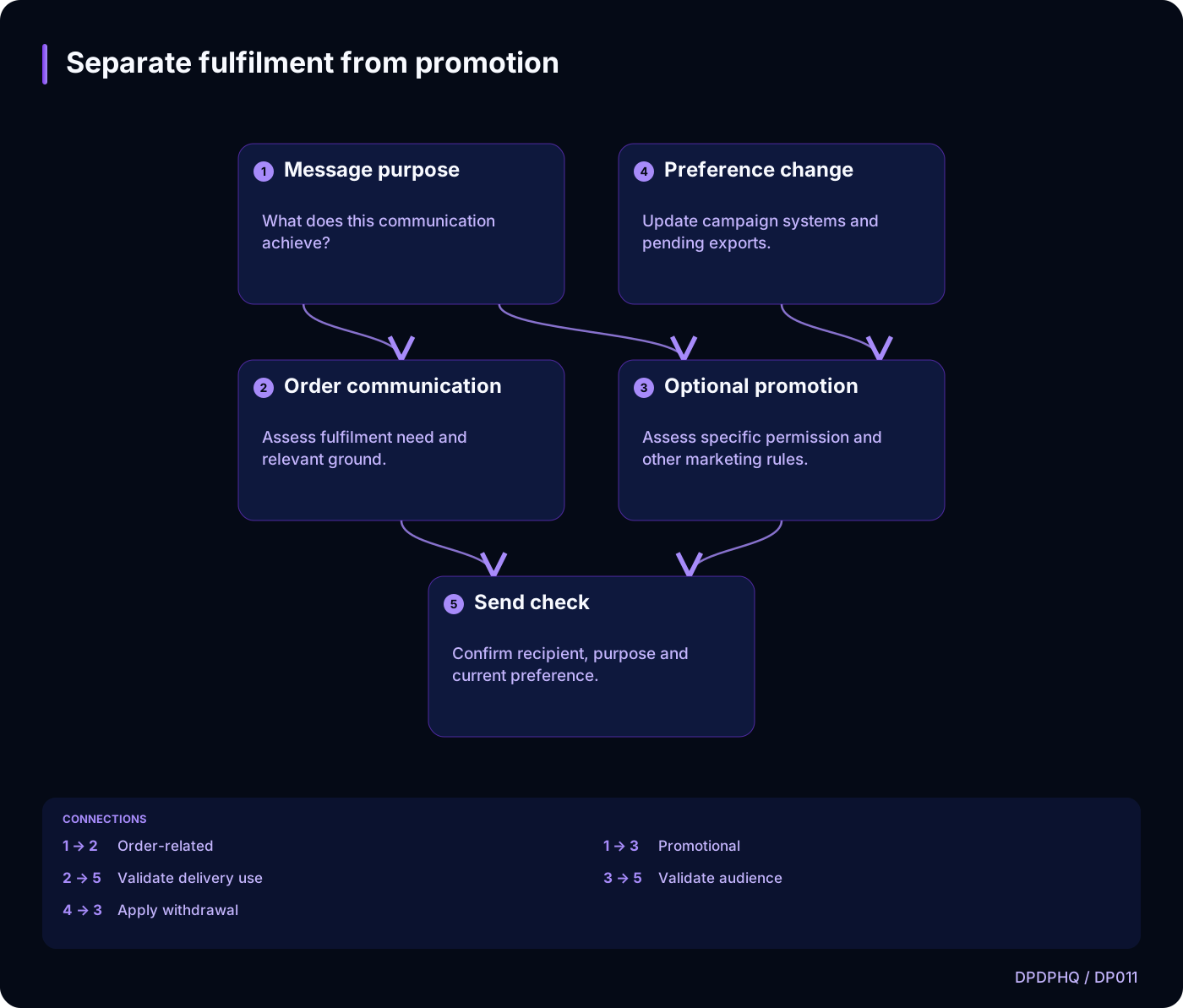
Separate fulfilment from promotion
Text version of the diagram
- Message purpose: What does this communication achieve?
- Order communication: Assess fulfilment need and relevant ground.
- Optional promotion: Assess specific permission and other marketing rules.
- Preference change: Update campaign systems and pending exports.
- Send check: Confirm recipient, purpose and current preference.
- Message purpose → Order communication: Order-related
- Message purpose → Optional promotion: Promotional
- Order communication → Send check: Validate delivery use
- Optional promotion → Send check: Validate audience
- Preference change → Optional promotion: Apply withdrawal
Sources and reading context
These references support the original 22 October 2026 research. Source links and the date above make the scope of this article explicit.
- Digital Personal Data Protection Act, 2023 · Sections 4, 5, 6 and 7(a)
Purpose, grounds and withdrawal
- Commencement notification for provisions of the DPDP Act · Paragraph (c)
Substantive commencement
- Digital Personal Data Protection Rules, 2025 · Rule 3
Notice and withdrawal route