Consent and notice · DP016
Consent records worth keeping, and data you can leave out
Keep consent evidence that explains the person, purpose, notice and action, while avoiding unnecessary recordings, identity documents and indefinite duplicate records.
Research cutoff: . This dated explainer is general information; check the linked instruments and your circumstances before acting.

An evidence record should answer a question, not simply occupy storage. If a customer disputes promotional consent, the business needs to explain what was presented, which purpose was involved and what the customer did. A database row containing only “consent: true” usually leaves important parts of that story missing.
Section 6(10) of the DPDP Act places the burden of proving notice and consent on the fiduciary when consent-based processing is questioned in a proceeding. As of 22 October 2026, this provision is scheduled for May 2027 under the commencement notification. The record design below is a suggested implementation, not a mandatory statutory schema.
Build the record around a decision
A useful starting set is a stable person or account reference, the specific purpose, the relevant notice version, the choice made, the time, the channel and the source system. Add information needed to interpret the event, such as whether it was a new choice, a change or a withdrawal.
The account reference should let authorised staff find the right decision without unnecessarily repeating full contact details in every log. The notice version should lead to preserved content rather than a webpage that silently changes. The purpose should be specific enough to distinguish promotional messages from delivery updates.
These fields are not a guarantee of valid consent. A perfectly recorded preselected box can still fail the underlying standard. Evidence must reflect a process that meets the Act’s requirements for a clear affirmative, informed and purpose-specific choice.
Preserve the explanation as well as the event
Imagine a hypothetical events company that offers an optional newsletter during registration. Six months later, it changes the wording and introduces partner promotions. A dispute concerns a choice made before the change.
If the company has only the latest notice, it cannot easily demonstrate what the earlier attendee saw. Keep a versioned copy of the relevant wording and enough interface context to understand the choice. A screenshot of a dummy screen can document layout without capturing unrelated customer data.
The final notice rule helps identify what the notice needs to explain. The business should link its evidence to that content rather than treating the existence of a policy PDF as proof of the specific request.
Record changes without rewriting history
When a person withdraws consent, preserve the fact that the earlier choice existed and that a later change occurred. The operational state should reflect the current decision; the history should explain how it reached that state.
Define how the withdrawal reaches campaign tools and other processors. A consent history that stops at the front-end button cannot show whether the relevant processing ceased. Keep completion evidence proportionate to the system: an acknowledged instruction, a processing result or an exception record may be useful.
Do not backdate corrections to make a mistaken record look clean. If staff entered the wrong preference, record the correction and its basis. An honest, understandable history is more useful than an apparently perfect log whose origin cannot be explained.
Leave unnecessary information out
Avoid collecting identity-document images, full device fingerprints or recordings of every conversation merely because they might strengthen evidence. Each added item has its own purpose, access and retention questions. More data does not automatically make proof better.
For a routine newsletter, a stable account reference and reliable event trail may be more proportionate than storing an identity document. A higher-risk workflow may need stronger verification. Make that choice based on the actual risk and requirement rather than applying the most intrusive method everywhere.
Also review free-text fields. Staff notes such as “customer seemed difficult” do little to prove consent and can introduce unnecessary personal commentary. Prefer factual descriptions of the action, channel and any unresolved issue.
Set retention by the applicable rule and purpose
The First Schedule, Part B prescribes at least seven years for specified records maintained by a statutory Consent Manager, whose registration framework is scheduled for 13 November 2026 under the commencement timetable. That is not a universal seven-year rule for every business’s consent database. Other retention provisions, including rule 8(3) and its at-least-one-year minimum for Seventh Schedule purposes in the later phase, require separate analysis.
Define a retention schedule for consent evidence that considers applicable requirements, dispute needs, current processing and the limits on further use. Restrict access to retained history and remove unnecessary duplicates. Do not interpret an evidence need as permission to preserve every customer interaction indefinitely.
Finally, test retrieval. Give an authorised reviewer a sample permission event and ask them to reconstruct the notice, purpose, action and current state. If they cannot do it without interviewing the original developer, the evidence design needs work before the volume grows.
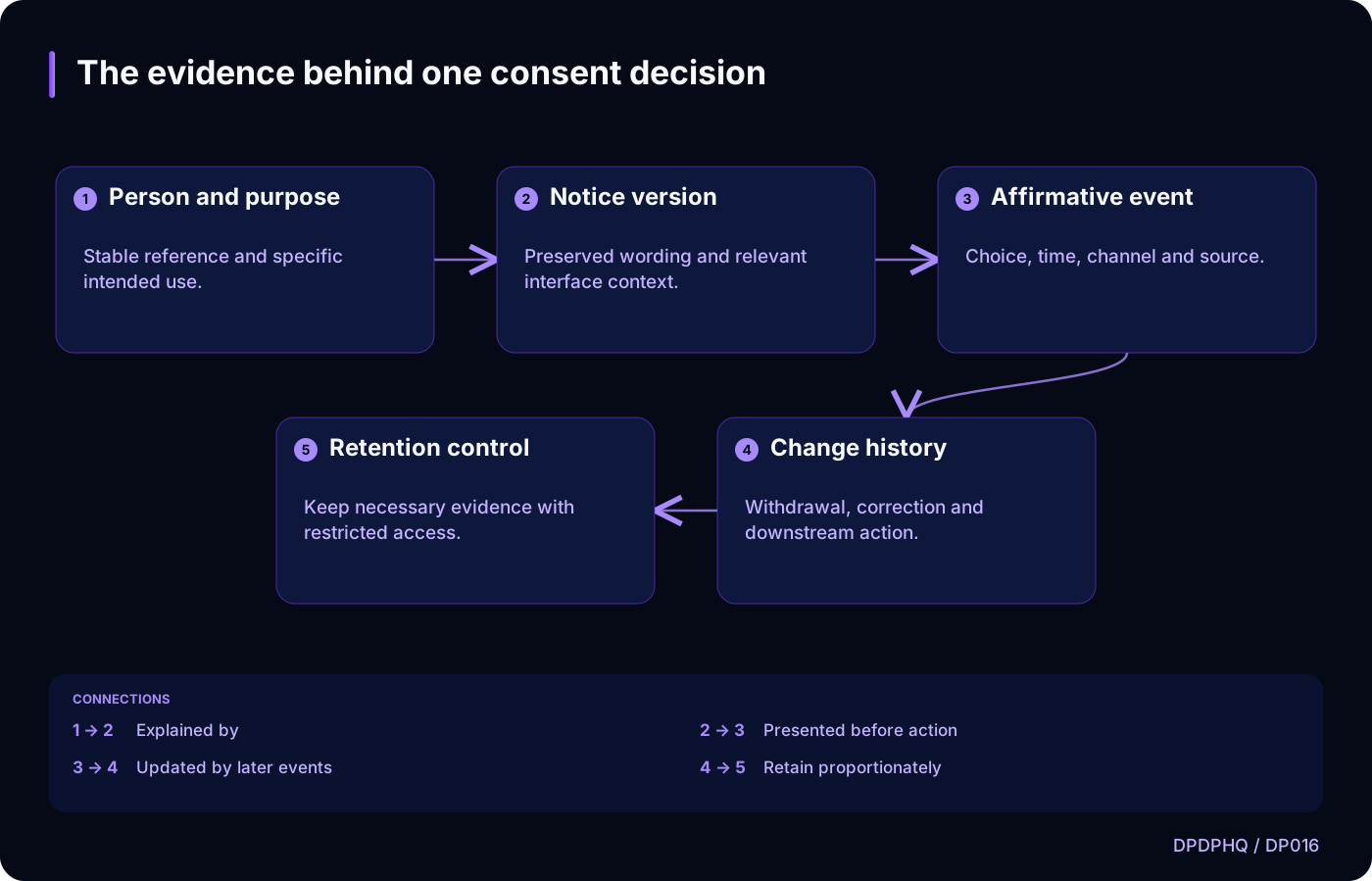
The evidence behind one consent decision
Text version of the diagram
- Person and purpose: Stable reference and specific intended use.
- Notice version: Preserved wording and relevant interface context.
- Affirmative event: Choice, time, channel and source.
- Change history: Withdrawal, correction and downstream action.
- Retention control: Keep necessary evidence with restricted access.
- Person and purpose → Notice version: Explained by
- Notice version → Affirmative event: Presented before action
- Affirmative event → Change history: Updated by later events
- Change history → Retention control: Retain proportionately
Sources and reading context
These references support the original 22 October 2026 research. Source links and the date above make the scope of this article explicit.
- Digital Personal Data Protection Act, 2023 · Section 6(1), (4)-(6) and (10)
Consent standard, withdrawal and proof
- Commencement notification for provisions of the DPDP Act · Paragraph (c)
Future commencement
- Digital Personal Data Protection Rules, 2025 · Rule 3, rule 8(3), First Schedule Part B items 3-4
Notice and distinct retention rules