Retail and local businesses · DP058
Running a loyalty programme with clear customer permissions
Design a loyalty programme that explains the membership data it needs and separates optional promotional uses.
Research cutoff: . This dated explainer is general information; check the linked instruments and your circumstances before acting.

A loyalty programme can be useful without becoming a quiet agreement to every future marketing idea. Customers may want points, a discount or a reliable record of their membership. They may have a different view about profiling their purchases, receiving frequent promotions or sharing their details with another business.
Design the programme around those distinctions. Start with a list of what membership actually delivers, then identify the data required to deliver it and any additional uses you want to offer.
Define the membership before designing the form
Write a short description of the core service: how points are earned, how they are redeemed and how a member is recognised. Decide whether a phone number is necessary for that design or whether another identifier can work. The answer will depend on the programme; there is no benefit in collecting a date of birth simply because another retailer does.
As of 22 October 2026, the relevant DPDP obligations are scheduled for 13 May 2027 under the commencement notification. When the consent provisions commence, section 6(1) will require consent to be specific and informed, among its other conditions, and limited to data necessary for the stated purpose. Section 5 will be relevant to the notice, with the final Rule 3 setting out its operational content.
Treat the mapping below as preparation for that framework, while checking any existing requirements that apply to your actual programme.
Make optional purposes visible
A useful programme description separates membership administration, necessary service communications, optional promotional messages and any proposed sharing or profiling. Do not hide a new purpose inside a broad sentence about improving customer experience.
For each purpose, identify the processing route you intend to use and the explanation the customer will receive. Where consent is the route, provide a clear affirmative choice. Do not assume that accepting the programme’s points rules supplies consent for an unrelated partner’s advertising. Equally, avoid adding unnecessary prompts for activities you have not actually assessed; a large pile of checkboxes is not a substitute for a clear purpose map.
Test the decline path. If the customer refuses optional promotions, what happens to membership? If a particular choice genuinely affects a service, explain the consequence accurately before the decision. An unexplained error message or a cashier’s threat to cancel points can undermine the clarity of the choice.
A hypothetical neighbourhood grocery programme
A grocery shop creates a points scheme using a member code and purchase totals. It also wants to send weekly offers. The owner keeps a membership record for points and a separate promotional preference linked to the code.
During enrolment, the customer can understand how the points work and whether they want offers. A staff member tries enrolling a test customer who declines messages. Points still accrue, and the campaign export omits that member. The owner then tests withdrawal after several purchases. The next campaign excludes the record without requiring a new account.
This example does not establish the legal basis for every possible loyalty design. It shows how to test the distinction the programme promises. If the shop later wants to analyse item-level purchases for tailored offers, that new use needs its own assessment rather than being silently added to the original arrangement.
Plan withdrawal before the first campaign
Under the coming section 6(4) to 6(6) framework, withdrawal must be possible with comparable ease, and processing based on that consent must stop within a reasonable time unless another legal authority or requirement permits continuation. Identify every system that sends messages, including outsourced campaign services and scheduled exports.
Separate stopping a use from deciding what records may need to remain. Section 8(7) and rule 8(3) with the Seventh Schedule require a careful retention assessment in the future framework. Do not promise that withdrawing from promotions will instantly erase every transaction or the evidence of that withdrawal. Restrict retained information to its justified purpose and prevent it from re-entering campaigns.
Keep the programme understandable as it grows
Review a proposed change against the original purpose map. A new reward partner, an app or a personalised recommendation feature can create new recipients and new uses. Update the operational design and the relevant explanation before launch, rather than relying on an old catch-all sentence.
The frequent failure is keeping the customer’s choice in one system while another system acts on an outdated list. Give someone responsibility for the whole path. A programme earns trust when the choice made at enrolment continues to control what actually happens later.
Separate membership from optional uses
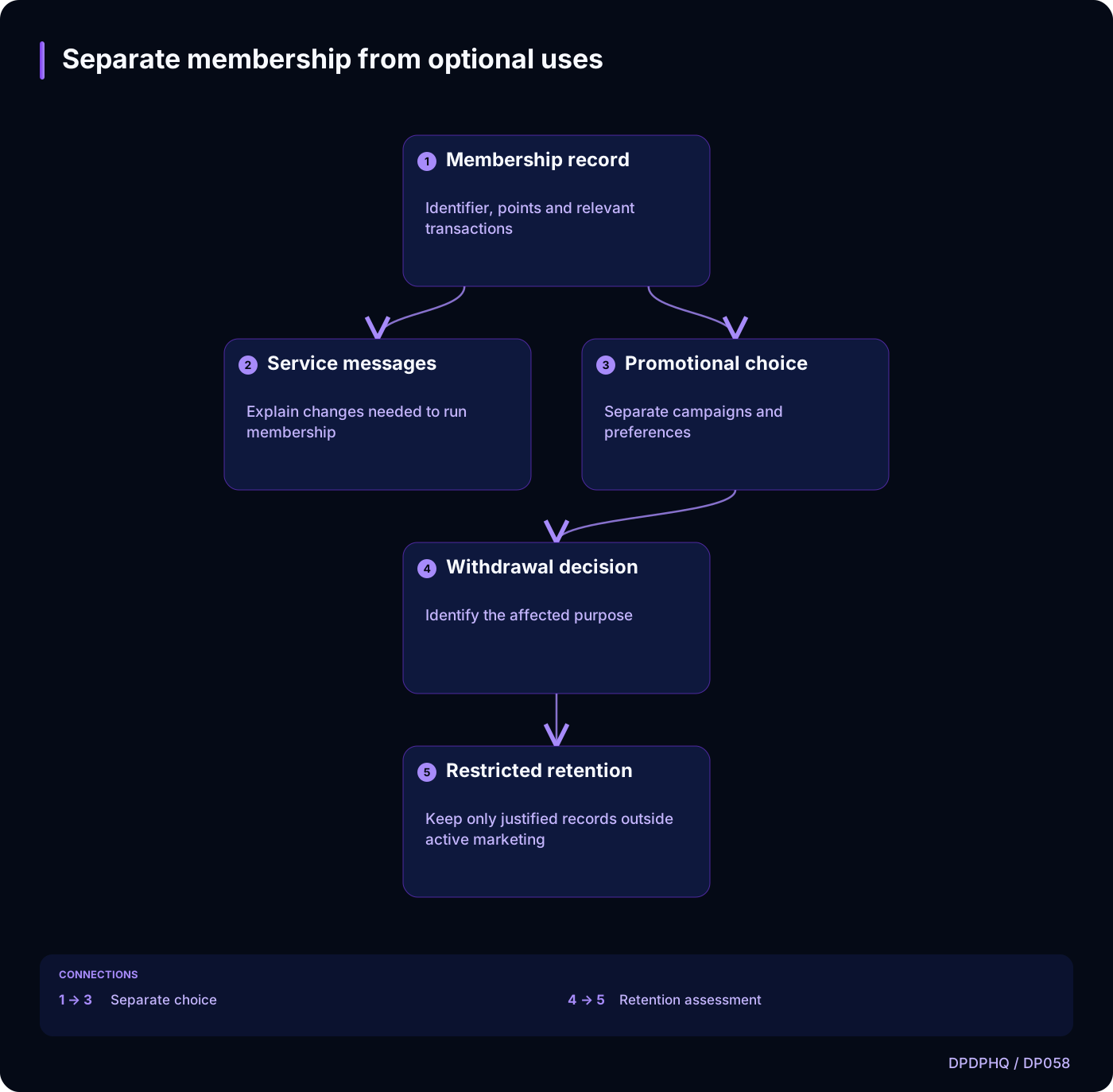
Text version of the diagram
- Membership record: Identifier, points and relevant transactions
- Service messages: Explain changes needed to run membership
- Promotional choice: Separate campaigns and preferences
- Withdrawal decision: Identify the affected purpose
- Restricted retention: Keep only justified records outside active marketing
- Membership record → Service messages
- Membership record → Promotional choice: Separate choice
- Promotional choice → Withdrawal decision
- Withdrawal decision → Restricted retention: Retention assessment
Sources and reading context
These references support the original 22 October 2026 research. Source links and the date above make the scope of this article explicit.
- Commencement notification for provisions of the DPDP Act · paragraph (c)
Clarifies commencement
- Digital Personal Data Protection Act, 2023 · sections 5, 6(1), 6(4) to 6(6), 8(7)
Supports notice, consent and withdrawal distinctions
- Digital Personal Data Protection Rules, 2025 · rules 3 and 8(3); Seventh Schedule
Notice detail and retention qualification