Operations and measurement · DP095
How to manage changes to notices and consent text
Classify notice changes by their meaning, preserve the version people saw and test whether the interface and downstream process match.
Research cutoff: . This dated explainer is general information; check the linked instruments and your circumstances before acting.

Consider two proposed edits. One shortens a consent sentence; the other expands appointment reminders to include promotions. Both produce a new text version, but they do not have the same significance.
Manage notice changes by meaning as well as wording. The record should explain what changed, why, which workflow was affected and what action was needed for the people concerned.
Separate editorial changes from processing changes
An editorial correction may improve grammar or clarity without changing the proposed use. A new purpose, data category, recipient arrangement or choice can require a more substantial assessment. Do not let a release note saying ‘copy update’ hide a change in the processing itself.
As of 22 October 2026, the relevant substantive DPDP provisions are scheduled for 13 May 2027 under the commencement notification. The future section 5 and rule 3 will shape the notice, while section 6(1) will require consent to meet conditions including being informed and specific. A notice edit alone cannot supply consent for a new purpose where a new decision is required.
Assess the actual route and change. Avoid the opposite error of asserting that every punctuation correction requires every person to consent again.
Keep a useful version record
Assign a version identifier to the text and record the effective date, language, interface location, purpose and approved wording. Preserve the previous version so an authorised reviewer can understand what was presented at a particular time.
Link the relevant decision evidence to that version and purpose. Under the coming section 6(10) framework, the fiduciary will bear the burden of proving the required notice and consent when consent-based processing is questioned in a proceeding. Version records are a practical way to support that task; the cited provisions do not mandate one universal database schema or notarisation method.
Avoid copying the complete personal payload into the version record. Keep the text history and the person’s event evidence connected through an appropriate reference, with access and retention assessed for each.
A hypothetical reminder change
A booking service originally asks for a contact route to send appointment reminders. The marketing team proposes adding promotional messages to the same sentence. The change reviewer identifies that the proposal alters the purpose rather than merely improving style.
The team separates the promotional use, assesses its route and designs the relevant choice. It tests that a person who declines promotions still receives the appropriate appointment service and does not enter the campaign export. The notice and actual behaviour are released together.
Later, a translator improves an awkward phrase without changing the approved meaning. That change receives a new text version and a meaning check, but the team does not automatically treat it as a new promotional permission. The decision record explains the distinction.
Review the complete interface
The notice can be clear while a button, checkbox or error message implies something different. Inspect the whole interaction on the relevant devices and in the supported language versions. Check the decline path, the withdrawal route and the place where the person can ask a question.
Keep the text and system configuration aligned. A new notice that promises a separate choice is misleading if the old bundled export continues to run. A backend change that adds a recipient also needs to trigger review of the relevant explanation.
When several teams own parts of the interface, name one release owner responsible for checking the combined result.
Handle historical consent carefully
Section 5(2) contains a specific future provision for consent given before commencement, including notice as soon as reasonably practicable and continued processing until withdrawal within that provision. Do not claim that every historic consent automatically becomes invalid or that every existing user universally needs a fresh opt-in.
Assess the actual prior basis, purpose and evidence. A history with no reliable record may present a different question from a well-documented consent for an unchanged purpose. Record the issue rather than using the legacy provision as a blanket cure for every old database.
Give changes an accountable route
Require a short proposal containing the reason, affected purpose, expected behaviour, source of the legal assessment and test evidence. Keep approvals proportionate to the change, with escalation for material uncertainty.
Keeping only the latest policy can lose the interaction that produced the original decision. A meaningful version record lets the business explain what a person was told, what they chose and how later changes affected that relationship.
Classify the change before publishing new text
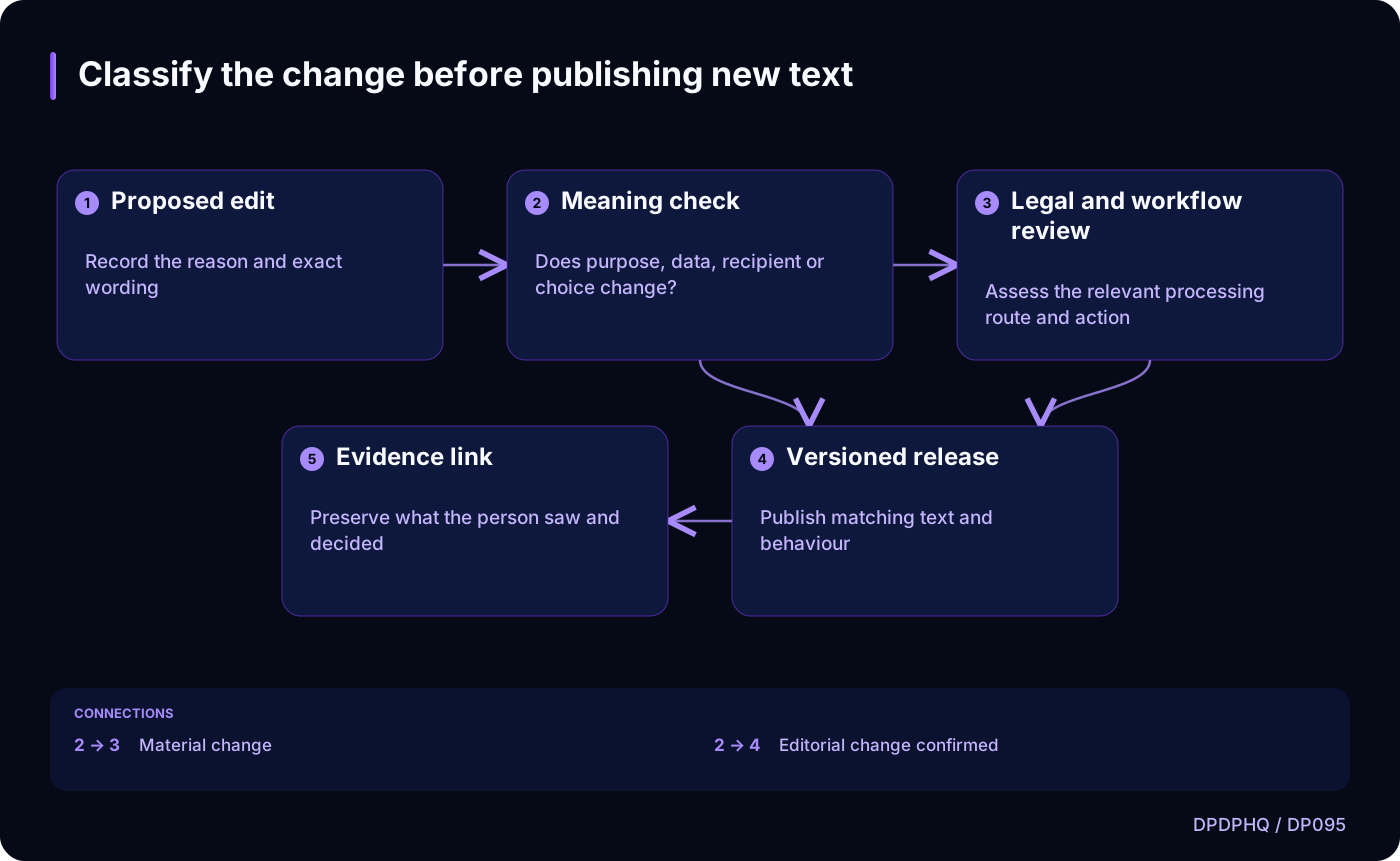
Text version of the diagram
- Proposed edit: Record the reason and exact wording
- Meaning check: Does purpose, data, recipient or choice change?
- Legal and workflow review: Assess the relevant processing route and action
- Versioned release: Publish matching text and behaviour
- Evidence link: Preserve what the person saw and decided
- Proposed edit → Meaning check
- Meaning check → Legal and workflow review: Material change
- Meaning check → Versioned release: Editorial change confirmed
- Legal and workflow review → Versioned release
- Versioned release → Evidence link
Sources and reading context
These references support the original 22 October 2026 research. Source links and the date above make the scope of this article explicit.
- Commencement notification for provisions of the DPDP Act · paragraph (c)
Dates future duties
- Digital Personal Data Protection Act, 2023 · sections 5(1), 5(2), 6(1), 6(10)
Notice, legacy consent, purpose and evidence
- Digital Personal Data Protection Rules, 2025 · rule 3
Notice content and usability